
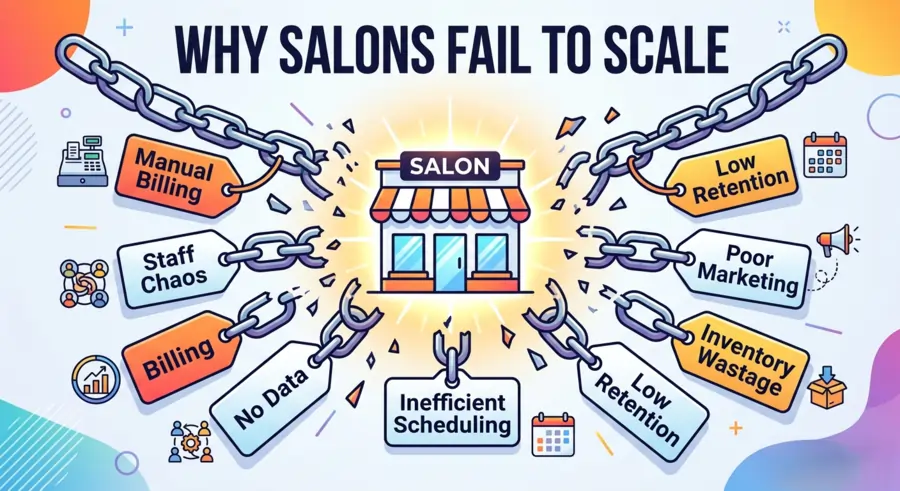
Opening your first salon is a dream come true. You’ve mastered the art of hair, skin, or makeup, and your local shop is buzzing with happy clients. But then, you decide to open a second location, and suddenly, everything falls apart. Does this sound familiar? You are not alone. The beauty industry is booming, yet why salons fail to scale remains one of the most painful and discussed topics for entrepreneurs in 2026.
The reality is that scaling a business is not just about renting more space or hiring more hands; it is about replicating excellence without your physical presence. Most owners are great stylists but struggle to become great CEOs. In this massive guide, we will explore the deep-rooted problems that stop growth and explain exactly why salons fail to scale so you can avoid these traps.
The Solopreneur Trap: Why You Are the Growth Bottleneck
The primary reason why salons fail to scale is often the owner themselves. In a single-location setup, you are the manager, the lead stylist, the accountant, and the receptionist. You handle every walk-in and troubleshoot every client complaint personally. While this works for one shop, it is a recipe for disaster for a chain.
When you open a second branch, your attention is divided. If your business depends on your “personal touch” to function, it isn’t a scalable business—it’s just a job you’ve created for yourself. To grow, you must stop being a “Stylist-Owner” and start being a “Business Strategist.” This requires delegating authority to a system rather than a person. Without a robust Salon CRM like Lokaci Pro, you will spend your entire day on phone calls instead of focusing on expansion. This lack of delegation is a core reason why salons fail to scale.
Lack of Standard Operating Procedures (SOPs)
Imagine walking into a famous burger chain. Whether you are in Delhi or New York, the burger tastes exactly the same. That is the power of SOPs. Most salons fail because they lack a “Manual of Operations.” When procedures are in people’s heads instead of on paper (or in software), consistency dies.
If Location A offers a premium experience but Location B feels unorganized and slow, your brand reputation will vanish. Scaling fails when the experience isn’t standardized. You need a system that ensures:
- Every client gets an automated SMS reminder.
- Every haircut follows a specific consultation process.
- Every billing transaction is handled professionally.
Standardization is the bridge between a local shop and a national brand. If you don’t document your processes, you will always be stuck in “firefighting” mode, which explains why salons fail to scale even with high demand.
Disconnected Systems: The Silent Growth Killer
As salons expand, their technical needs become complex. Most owners start with a notebook, a basic WhatsApp group, and a simple POS system. But as you grow, these disconnected tools create “Data Silos.” This technical debt is a significant factor in why salons fail to scale.
One of the biggest reasons why salons fail to scale is the friction caused by using different tools for different tasks. Your booking software doesn’t talk to your inventory, and your inventory doesn’t talk to your billing.
- The Result: You spend 15-20 hours a week manually reconciling data across multiple branches.
- The Solution: You need a unified platform where bookings, payments, and staff scheduling live under one roof.
When your systems don’t talk to each other, you lose the “single source of truth” needed to make executive decisions. This confusion is a primary driver behind why salons fail to scale.
Manual Staff Management and Commission Chaos
Staffing is the backbone of the salon industry. However, as you scale, managing 50+ stylists across multiple locations becomes a nightmare. If you look at the data on why salons fail to scale, staff turnover is always at the top of the list.
Why salons fail to scale often boils down to staff dissatisfaction. If your commission calculations are manual, mistakes are inevitable. If a stylist feels their hard work isn’t being tracked correctly, they will leave and take your clients with them.
- Manual Overhead: Using Excel sheets to calculate complex commissions for various services is prone to error.
- Transparency: Top talent stays where the system is transparent.
By using a platform like Stylelink for hiring and Lokaci Pro for tracking individual performance metrics (KPIs), you ensure your staff remains motivated. You need to know who is driving revenue and who is underperforming—in real-time, across all branches. If you can’t manage your people, you can’t manage your growth, which is exactly why salons fail to scale.
Operational Blind Spots: No Real-Time Data
When you have one salon, you can “feel” the business. You know it’s a busy Saturday because the floor is crowded. But when you have five salons, you cannot rely on “feelings.” Operational blind spots occur when you lack real-time data visibility, and this is a major reason why salons fail to scale.
If you don’t know which branch has the highest seat utilization or why one location is losing clients, you are flying blind. This lack of clarity is exactly why salons fail to scale profitably. You need a centralized dashboard that shows:
- Revenue per location vs. Operating cost.
- Service popularity trends (What’s trending in Branch A might fail in Branch B).
- Customer behavior insights and lifetime value.
- Staff productivity and attendance levels.
Without these insights, you are guessing, and guesswork is why salons fail to scale in a competitive market.
Inventory Leakage and Supply Chain Resource Drain
Inventory management is the most ignored aspect of salon scaling. In a single shop, you can physically see the shelf. In a chain, you lose track of stock quickly. This financial leak is a hidden reason why salons fail to scale.
- The Problem: Staff might over-use expensive products, or worse, products might go missing without a record.
- The Cost: Industry experts suggest that up to 30% of salon profits are lost in “inventory leakage.”
To scale effectively, you need a smart inventory control system. You need auto-reorder alerts and “usage per service” tracking. If you are still ordering products via phone calls instead of using a streamlined supply chain like Zubito, you are losing money every single day. This loss of margin is a key answer to why salons fail to scale.
The High Cost of Customer Acquisition vs. Retention
Many owners think that opening a new branch is just about getting “new” customers. However, the cost of acquiring a new customer is 5x higher than retaining an existing one. If you don’t have an automated retention strategy, you will find out the hard way why salons fail to scale.
A major reason why salons fail to scale is that they focus so much on the “new” that they forget the “old.” If your first branch loses 40% of its clients while you are busy setting up your second branch, you aren’t growing—you are just shifting problems.
Automation is the key here. You need a system that brings customers back automatically through:
- Birthday and anniversary campaigns.
- Service reminders (e.g., “It’s time for your root touch-up!”).
- Win-back journeys for clients who haven’t visited in 60 days.
- Loyalty points that can be redeemed at any branch seamlessly.
Financial Mismanagement and Cash Flow Gaps
Wait, there’s more. Why salons fail to scale is often linked to poor cash flow management. When you have multiple locations, you have multiple rents, multiple electricity bills, and multiple payrolls. If your billing system isn’t GST-compliant or doesn’t track digital payments accurately, you will face a cash crunch.
Scaling requires “Reinvestable Profit.” If your overheads are growing faster than your revenue because of manual inefficiencies, your expansion will collapse. This is a common pattern in why salons fail to scale beyond the three-location mark.
Why Lokaci Pro is the Digital Foundation for Growth
Many owners think that buying more furniture and hiring more staff is “scaling.” It’s not. Scaling is about building the digital infrastructure that allows your business to run without your constant supervision.
The #1 reason why salons fail to scale is the lack of a centralized “Command Center.” This is where Lokaci Pro changes the game. It is designed to solve these multi-location headaches by offering:
- Unified Operations: Manage all your branches, bookings, and payments from one dashboard. No more traveling between shops just to check the registers.
- Smart Billing: GST-compliant invoices and split payments to handle complex transactions seamlessly, increasing average ticket size by 25%.
- Real-Time Analytics: Move from guesswork to data-driven growth with custom reports that show you the health of your entire business.
- The Ecosystem: Seamlessly connect with Stylelink for your hiring needs and Zubito for your product supply chain.
By solving the fundamental problems of why salons fail to scale, Lokaci Pro empowers you to focus on the big picture.
Frequently Asked Questions (FAQs)
Q1: Why is the second location always harder than the first one?
The first location succeeds because of the owner’s direct presence. The second location often struggles because that presence is missing. Understanding why salons fail to scale starts with realizing you need systems to replace your physical presence.
Q2: How does automated billing increase salon revenue?
Automated billing reduces human error, prevents “under-the-table” transactions, and allows for upselling recommendations (like combos and packages), which helps overcome the stagnation of why salons fail to scale.
Q3: Can I track inventory for 10 different locations at once?
Yes. With Lokaci Pro’s multi-location mastery, you can monitor stock levels, usage, and reorder alerts for all your branches from a single screen, solving the inventory leakage problem that explains why salons fail to scale.
Q4: What is the most common mistake in salon staff management?
Lack of transparency in commissions and performance tracking. When staff can see their earnings in real-time, they are more motivated, reducing the turnover that is a hallmark of why salons fail to scale.
Q5: Is it expensive to implement a Salon CRM like Lokaci Pro?
Compared to the cost of losing clients, inventory leakage, and manual errors, a Salon CRM is a high-ROI investment. In fact, NOT having a CRM is the main reason why salons fail to scale profitably.
Conclusion
Scaling a salon business is a transition from being a craftsman to being a CEO. The reasons why salons fail to scale almost always trace back to a lack of systems, data, and standardized processes. When you rely on manual workarounds, you hit a growth ceiling very quickly. However, when you embrace technology, you build a foundation for limitless expansion.
Now that you know why salons fail to scale, it is time to take action. Stop managing your salon like it’s 2010. Embrace the power of AI-driven scheduling, automated billing, and centralized management to turn your single shop into a thriving nationwide brand.
Latest on Lokaci Pro
Ready to take your salon to the next level? Don’t let operational chaos stop your growth. Lokaci Pro is the #1 AI Salon CRM designed for modern businesses that want to run smarter and avoid the traps of why salons fail to scale. From smart appointment systems to multi-location mastery, we provide the digital infrastructure you need to succeed in the lifestyle economy.
- Unified Operations: Bookings, payments, and reporting in one system.
- Real-Time Insights: Instant visibility into revenue and trends.
- Built to Scale: Designed for multi-location, multi-team salon businesses.
Start Your Free Demo Now
Find Your Perfect Plan
Join the Lokaci Ecosystem today and experience the shift from manual overhead to unified, profitable operations.
Grow Your Salon Business with Lokaci Pro
Manage appointments, billing, staff commissions, inventory, CRM, WhatsApp reminders and multi-location operations — all in one powerful salon management system.
Book Free Demo